
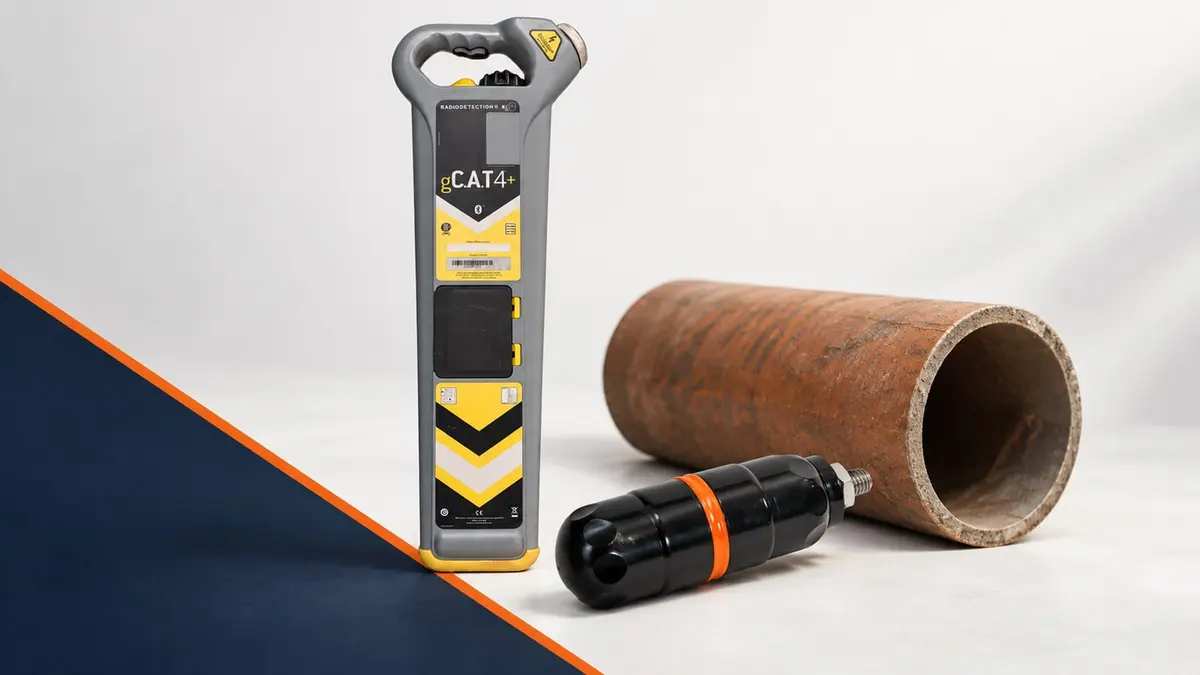
Precision Drain Repair with Sonde Locating
Precision drain repair starts with knowing exactly where the defect is. You push a drain camera with a built-in sonde to the fault, then locate the sonde from the surface to get its precise position and depth. That lets a repair crew dig one accurate hole straight onto the problem, instead of excavating a long trench and hoping. It is the difference between a half-day repair and a wrecked driveway.
Finding the defect is only half the job; pinpointing it for the digger is what saves time and money. Here is the locating method that makes no-dig and dig repairs efficient.
Why locate the defect, not just see it?
A camera tells you a drain is collapsed at, say, 12 metres. But 12 metres of push-rod is not a straight line on the surface; the drain bends. Without locating, the repair crew either digs a long exploratory trench or guesses and digs twice. Pinpointing the camera head from above converts "somewhere around 12 metres in" into "here, 1.1 metres down", which is what the excavator actually needs.
How does sonde locating work?
- Push the camera to the defect and stop with the sonde right at the fault.
- Switch your locator to the camera's sonde frequency (often 33kHz or 512Hz).
- Find the peak signal directly over the sonde, then mark the ground.
- Take a depth reading so the dig is planned, not exploratory.
For tight or cast-iron pipes a 512Hz sonde holds up better; for deeper drains 33kHz reaches further. The frequency trade-offs are covered in advanced sonde tracing.
Where precision locating pays off
- Spot repairs: one neat excavation onto a collapse or displaced joint.
- No-dig lining: confirming the exact extent and position of a defect before patch lining.
- Connection mapping: proving where a lateral joins before work begins.
- Protecting surfaces: sparing a driveway, road or garden from a long trench.
Getting an accurate mark
Keep the locator vertical, find a clean signal peak rather than a broad area, and confirm depth before you commit. A weak sonde battery gives a vague signal, so check it. The same accuracy habits from cable locating apply here; see tips for accurate locating.
The takeaway
A survey that finds the defect and locates it precisely is worth far more than one that just films it. Build sonde locating into every survey and your repairs get faster and cleaner. For the full workflow, see the professional drain CCTV handbook, and browse cameras with built-in sondes.