
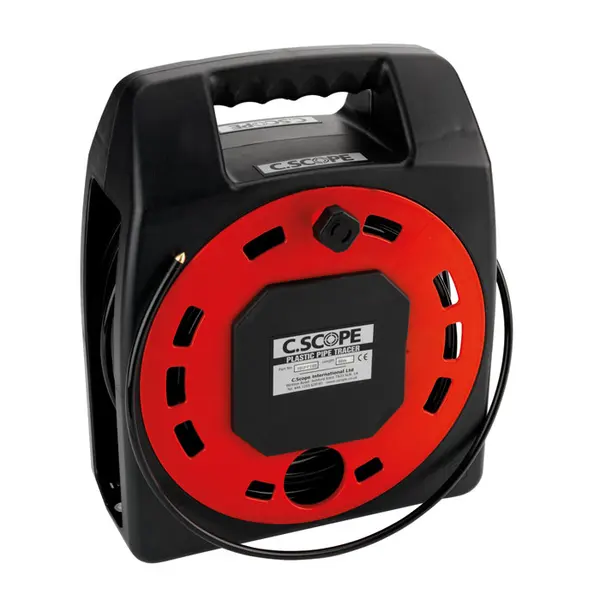
C.Scope YIRPPT50-33 50 m Plastic Pipe Tracer – 33 kHz
Trace the route of a small non-metallic pipe or pinpoint how far the tracer has reached. The C.Scope YIRPPT50-33 has a 50 m rod with a 6 mm integrated sonde tip. Condition: New.
Follow the route or find the tip
The tracer puts a detectable signal inside a pipe that a locator cannot detect directly. Use line detection to follow the inserted rod, or tip detection to locate its end. C.Scope quotes detection depths of up to 3 m for the line and up to 4 m for the tip. Both depend on the locator, signal generator and site conditions; neither is a guaranteed depth.
Check both the transmitter and receiver
Match the tracer to a signal generator or transmitter with a 33 kHz output or a combined 33/131 kHz output. The receiver must be able to detect the tracer’s 33 kHz signal (32,768 Hz). Check your models’ specifications rather than relying on the brand name alone. If you need either part of the system, compare signal generators and pipe and cable locators.
Choose the length for the job
If your runs are short, compare the 20 m option in the C.Scope Plastic Pipe Tracer range. It has the same 6 mm rod and tip diameter and a lighter reel. Choose this 50 m version when you need more rod from the same access point. If 50 m is not enough, compare the C.Scope 80 m Flexible Tracer, but check its dimensions against the opening and bends before choosing it.
Specifications
- Manufacturer part number
- YIRPPT50-33
- Rod length
- 50 m
- Rod and sonde diameter
- 6 mm
- Minimum rod bend radius
- 50 mm
- Reel dimensions
- 165 × 290 × 240 mm
- Reel weight
- 2,073 g
- Operating and storage temperature
- −20 °C to +50 °C
- Ingress protection
- IP68 for the rod and tip; IP54 for the casing
How do bends and fittings affect how far the tracer will go?
C.Scope specifies use in pipes down to 10 mm, but check the clear internal opening at fittings as well as the pipe bore. Tight bends or restricted fittings can stop the rod before all 50 m is inserted. Check the route against the rod’s minimum bend radius before choosing a length.