
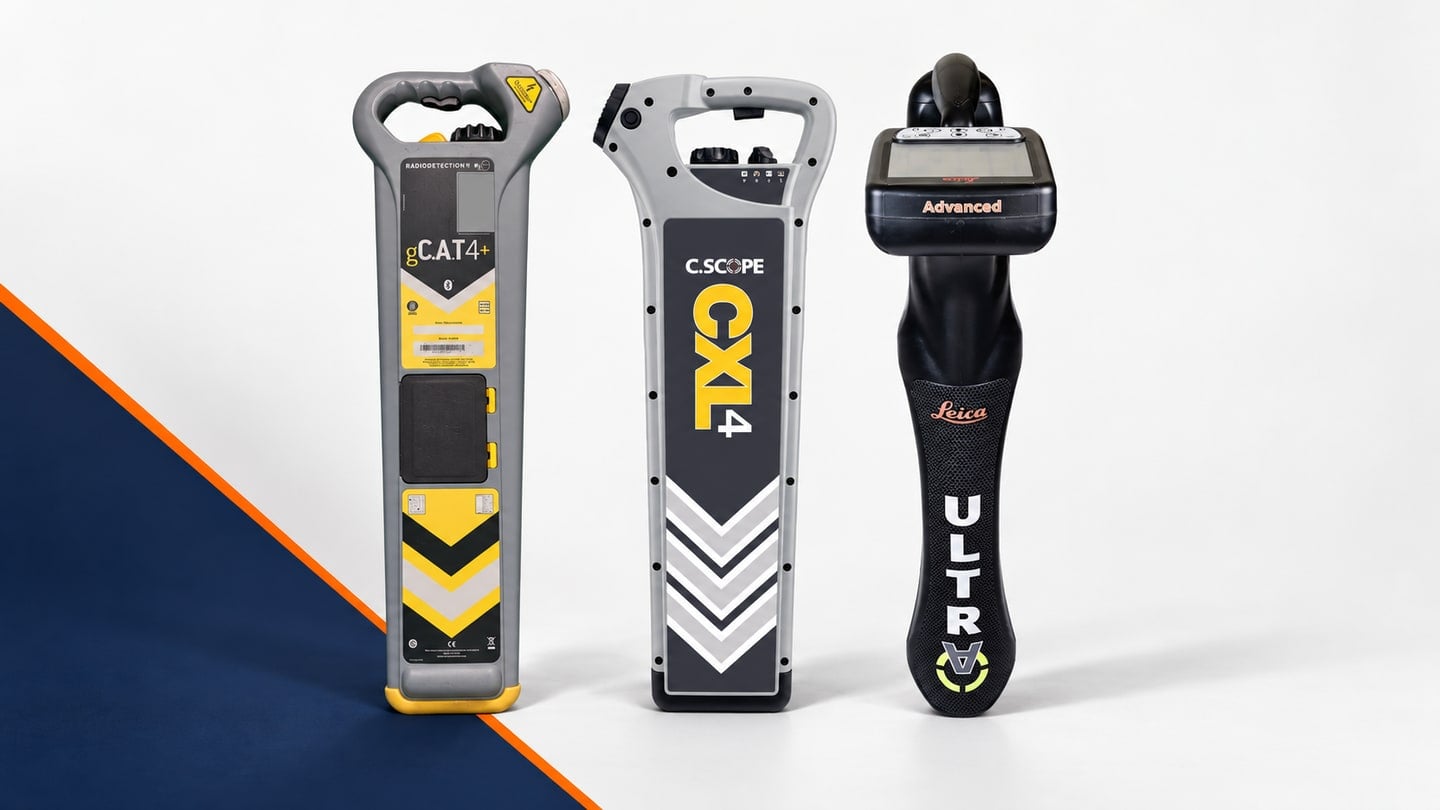
CAT4 vs C.Scope vs Leica ULTRA: 2026 Comparison
For most UK utility work the Radiodetection CAT4 is the default choice on durability and resale; the C.Scope CXL4 wins on value and simplicity; and the Leica DD/ULTRA range leads on advanced multi-frequency locating and survey-grade data. The right one depends on whether you prioritise fleet standardisation, budget, or locating depth and accuracy.
These are the three brands you will realistically choose between in 2026. They all locate buried services competently. The differences are in build, features, software and price, and that is what this teardown focuses on.
Radiodetection CAT4: the industry standard
The CAT4 is the unit you see on most UK sites, and that ubiquity is its biggest strength. Operators already know it, hire desks stock it, and resale values stay strong. The CAT4+ adds depth readout and StrikeAlert for shallow services; data-logging models record every sweep for compliance. It is rugged, simple to teach, and backed by the widest accessory range.
- Best for: contractors who want a fleet standard and strong resale.
- Watch: you pay a premium for the badge.
- Shop: Radiodetection CAT4 kits, or a reconditioned CAT4 and Genny4 kit for the best value.
C.Scope CXL4: the value option
C.Scope is the long-standing British alternative. The CXL4 covers Power, Radio and Genny modes, does the core job reliably, and costs noticeably less than the equivalent Radiodetection unit. It is straightforward, light, and a sensible choice for smaller teams or as a second unit. You give up some of the data-logging sophistication and the secondhand-market depth of the CAT4.
- Best for: budget-conscious buyers and occasional users.
- Watch: smaller resale market, fewer fleet-management features.
Leica DD and ULTRA: the locating specialist
Leica's locators (the DD-SMART series and the ULTRA utility locating system) target the surveyor who needs more than avoidance. Multiple simultaneous frequencies, better discrimination between adjacent services, GPS-tagged data and tight integration with survey workflows make them the pick for utility mapping and PAS 128 work. That capability comes at the highest price and a slightly steeper learning curve.
- Best for: utility surveyors and mapping to PAS 128.
- Watch: premium price; more tool than a pure avoidance job needs.
Head to head
| Radiodetection CAT4 | C.Scope CXL4 | Leica DD/ULTRA | |
|---|---|---|---|
| Strength | Standard, rugged, resale | Value, simplicity | Multi-frequency, survey data |
| Data logging | Yes (top models) | Limited | Advanced, GPS-tagged |
| Price | Premium | Lowest | Highest |
| Ideal user | General contractor fleet | Smaller teams | Utility surveyor |
Which should you buy?
If you want one answer: buy a CAT4 (new for a big fleet, refurbished for everyone else) because it is the safe, supported, resaleable standard. Choose C.Scope to stretch a tight budget, and Leica when locating accuracy and survey-grade data are the actual job. Still deciding between new and used? Our cost-benefit analysis runs the numbers, or browse the full cable avoidance range.