
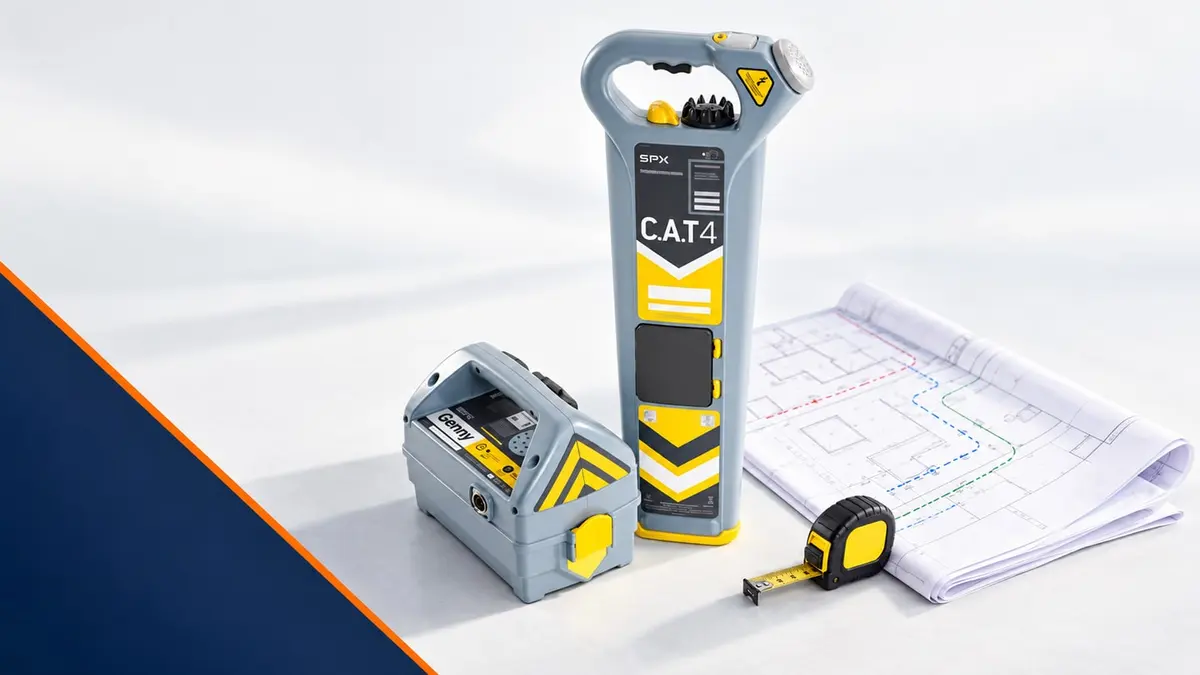
Tips for Accurate Cable Locating
Accurate locating starts with a planned search, appropriate equipment and a response you can investigate consistently. Use the modes and methods supported by your instrument, check for signal distortion, and treat depth as an estimate. A quiet receiver does not show that the ground is clear.
Start with the work plan and service information
HSE's HSG47 treats planning, locating and identifying services, and safe excavation as parts of one safe system of work. Use available plans and site information to guide the search, while allowing for services that are missing, displaced or inaccurately recorded. Locating equipment and the person using it must suit the task.
Check the kit before relying on a response
Inspect the receiver, transmitter, connection leads, clamps and power accessories. Carry out the manufacturer-specified functional checks in suitable conditions. Remove damaged or faulty equipment from use; an in-date calibration record does not override a failed check. See calibration, function checks and maintenance.
Search systematically using the supported modes
Cover the work area methodically, using the instrument's prescribed orientation and search technique. Passive modes depend on signals already present on a service; active tracing applies a transmitter signal. Their usefulness changes with the service, its electrical state, the environment and the equipment. Different CAT and precision RD models support different modes and frequencies.
Choose the signal application method for the job
Direct connection, a suitable transmitter clamp and induction have different requirements and limitations. Direct connection requires an appropriate accessible connection and competent use. Clamp application still needs the correct equipment and safe access. Induction can energise more than the intended service and can couple directly to the receiver. Follow the instructions for the chosen method rather than treating any method as a universal guarantee.
Standard connection leads are not a general-purpose method for connecting to live conductors. Work on or near electrical services requires the appropriate competence, equipment and procedures.
Check whether you are following the intended utility
Trace the response along its route and investigate changes, unexpected branches or inconsistent measurements. Adjacent services can carry an applied signal. Where supported, signal-current information, different locating modes and Current Direction can help an operator assess the response, but each requires correct use and compatible equipment. A strong signal alone does not establish utility identity.
Keep depth in its proper role
Depth readings can be affected by signal distortion and the measurement conditions. Radiodetection's RD8200 manual warns against using depth readings to define mechanical digging depths. Follow the applicable verification procedure and the site's safe excavation method. Do not turn a displayed number into a permitted excavation clearance.
For non-metallic pipes or drains, a compatible sonde or traceable system may provide the required signal. Read the sonde selection and compatibility guide. Browse precision locators by the functions required for the work, and use training appropriate to the system.
References
HSE HSG47 and the locating, signal-application, depth and safety sections of the Radiodetection RD8200 operation manual V7. This guide supports selection and understanding; the exact instrument's instructions govern its operation.