
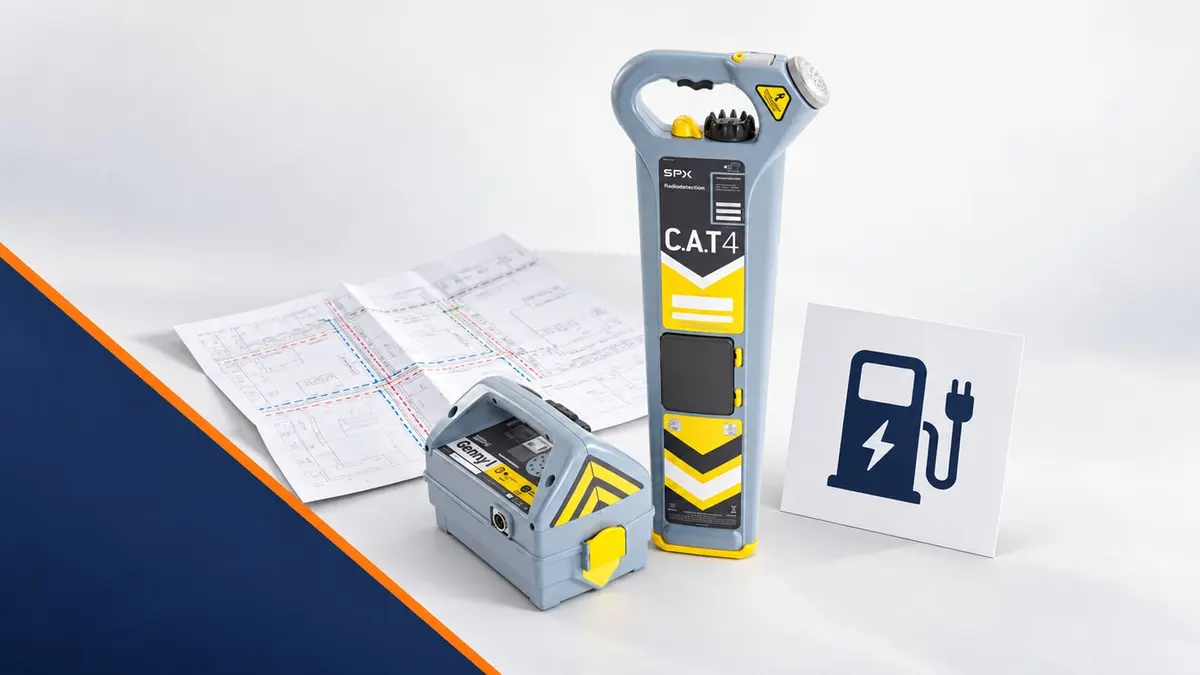
Locating Near 25kV Rail and EV Charging Hubs
Near 25kV overhead rail lines and high-power EV charging hubs, electrical noise floods a CAT's Power mode and can hide the very cable you are looking for. The rule in these high-interference zones is simple: never trust passive Power mode. Apply a clean 33kHz Genny signal, use direct connection or a clamp, and treat any silence as suspect.
The UK is electrifying fast, and that creates locating environments that defeat standard technique. Here is how to stay accurate where the air is full of interference.
Why does interference defeat a CAT?
Power mode is tuned to the 50Hz hum of mains cables. In a quiet area a buried cable stands out clearly. Under a pylon, beside a 25kV catenary, or next to a 150kW rapid charger, the surrounding electromagnetic noise is enormous. The CAT's receiver gets swamped: the bargraph pins to 100%, or dances at random, and a real cable signal disappears into the background.
The EV charging hub problem
Rapid chargers use high-speed switching electronics that throw out harmonics, dirty frequencies that bleed across the spectrum. The danger is subtle: you scan a charging bay, the CAT reads nothing, and you assume it is clear. In reality the charger's noise has masked the supply cable's signal. Never read a quiet CAT near a charger as safe. Prove the supply with a Genny.
The 25kV rail problem
Network Rail's overhead lines carry 25,000 volts and generate a powerful magnetic field that penetrates the ground. Trackside, a CAT can scream constantly, a state called dynamic overload. The CAT4's Dynamic Overload Protection filters generic high-voltage noise, but it has limits; directly under the line you are effectively blind in passive modes.
Three tactics to beat the noise
- Hop frequency with the Genny. Apply a clean active signal and locate on that instead of fighting 50Hz noise. Higher Genny frequencies cut through magnetic interference better.
- Connect directly. If you can clamp or clip onto the target service, the applied signal will be strong enough to punch through the background.
- Sweep across the source. Interference tends to run parallel to its source (the rails or the supply). Scan at 90 degrees to it to find a quieter line where the buried signal can show through.
The safe habit
In high-interference zones, silence is not safety; it usually means your receiver is overloaded. Always prove the line with a Genny, lean on direct connection, and slow right down. For the underlying method see the 2026 ultimate guide to cable avoidance and our accurate locating tips, and make sure your CAT and Genny is up to working trackside.